

Stakeholder capitalism is a business approach that prioritizes the interests and well-being of all stakeholders—employees, customers, communities, and the environment—over the exclusive pursuit of shareholder profit. For leaders, mastering stakeholder capitalism now means understanding how to balance these interests with measurable social and environmental impact. By the conclusion of this article, readers will be equipped to evaluate, implement, and optimize stakeholder engagement, select suitable impact measurement frameworks, and navigate common challenges that arise in reporting and governance.
A profound transformation is reshaping how organizations define success. With institutional investors steering nearly $30 trillion toward ESG assets by the end of this decade, and 90% of executives confirming their firms are shifting to stakeholder capitalism, measurement of social and environmental impact has become non-negotiable for boardrooms, C-suites, and operational leaders alike. What separates intent from action—and greenwashing from authentic impact—is a leader’s ability to operationalize stakeholder capitalism through rigorous, transparent methods of impact measurement and reporting.
Modern businesses face a critical evaluation challenge: How do we move from aspirational values to demonstrable, verifiable outcomes? How do we make these outcomes comprehensible for diverse audiences, all while sustaining business performance? Addressing these questions is now table stakes for organizations aiming to build trust, secure capital, and thrive long term.
Understanding the Landscape: Stakeholder vs. Shareholder Capitalism
Shareholder capitalism relies on the principle that a company’s primary duty is to maximize value for its shareholders. Traditionally, this meant optimizing for quarterly profits, sometimes at the expense of employees, customers, or the wider community.
Stakeholder capitalism redefines the purpose of business: value must be created and distributed among all those touched by a company’s activities. This includes employees, customers, suppliers, local communities, and the planet. The World Economic Forum’s Stakeholder Capitalism Metrics, adopted by over 120 major companies, exemplify this shift toward holistic, standardized performance measurement.
Practical implications include:
- Governance: Boards must weigh not only financial returns, but also environmental, social, and governance (ESG) objectives.
- Strategy: Profitable growth is calibrated alongside measurable benefits for stakeholders.
- Reporting: Annual reports are now expected to include impact metrics, not just financial statements.
90% of C-suite leaders say their companies are actively moving toward a stakeholder capitalism model impacting 80% of firms globally. (Source: The Conference Board, Deloitte, 2021)
The pros of stakeholder capitalism are resilience, reputation, and access to impact-driven capital. The cons center on complexity: balancing competing interests can slow decision-making and requires advanced stakeholder mapping, engagement, and measurement tools. While shareholder capitalism offers clarity of purpose, it exposes organizations to reputational and regulatory risks in a world where stakeholder interests can no longer be ignored.
For modern organizations, thriving means not only excelling financially but also strengthening their social and environmental backbone through transparent stakeholder engagement and impact reporting frameworks.
The Core of Impact Measurement: Frameworks & Methodologies
Impact is only as credible as the way it’s measured. Leading organizations employ structured methodologies to gather, analyze, and report social and environmental outcomes. The choice of framework shapes everything—from board-level strategy to daily operations.
Key Frameworks:
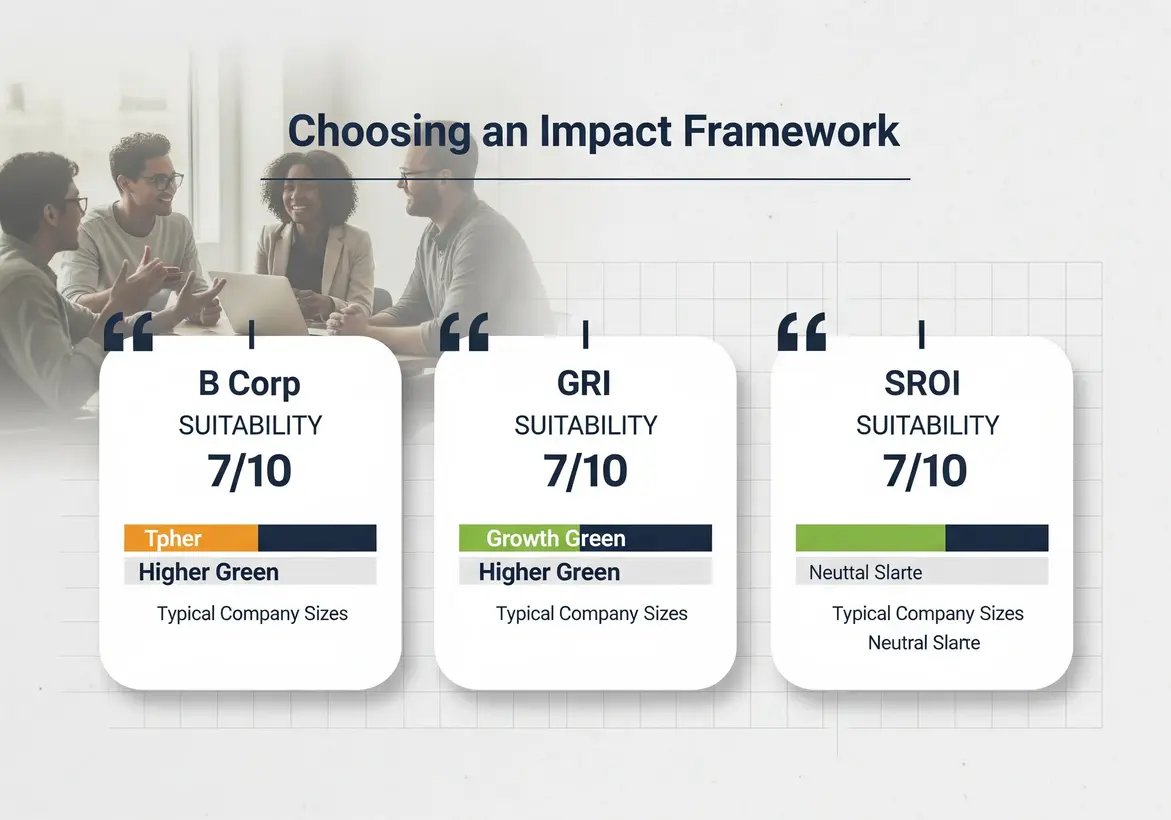
- SROI (Social Return on Investment): Quantifies social returns alongside financial ones; for every $1 invested, how much social value is generated? Widely used in non-profit and corporate social investment, SROI offers a disciplined, defensible metric. Limitation: Resource-intensive, requires advanced data collection. (Source: Ohio University, ‘SROI: How Organizations Measure Social Impact’)
- B Corp Impact Assessment (BIA): A rigorous, standardized tool evaluating a company’s performance across governance, workers, community, environment, and customers. BIA forms the basis for B Corp certification.
- GRI (Global Reporting Initiative): The most popular framework for sustainability disclosure; mandates comprehensive, auditable reporting on a broad set of ESG metrics for stakeholders and investors.
- SDGs Alignment (UN Sustainable Development Goals): Provides a universal language for impact, helping companies frame their activities around 17 global goals.
Framework Chooser Guide:
When selecting a measurement framework:
- Business Size & Maturity: Smaller companies may favor the modular B Corp Impact Assessment, while multinationals often benefit from the extensiveness of GRI Standards.
- Industry & Regional Regulation: Heavily regulated industries (such as energy, finance) may select GRI for compliance, while consumer brands may lean into SDG framing for accessible communication.
- Purpose & Audience: Pursuit of B Corp status necessitates BIA mastery, while philanthropically oriented businesses extract most value from SROI’s monetization of outcomes.
- Desired Level of Quantification: SROI provides deep, monetizable insights, while GRI suits high-level, standardized disclosure.
Unifying all these is the emphasis on social and environmental impact measurement that stands up to external scrutiny and builds genuine data-driven trust.
Conquering the Challenges: Pitfalls in Data Collection & Engagement Measurement
Impact measurement is only as reliable as the data—and processes—behind it. Common pitfalls include:
- Resource Intensity: 63% of companies underestimate the time, expertise, and technology needed to collect and validate impact data.
- Disorganization & Siloed Data: Data is often spread across functions, making aggregation slow and error-prone.
- Unsubstantiated Impact Claims: Risk of “greenwashing” rises when narratives outpace hard evidence, eroding trust.
- Qualitative Data Blind Spots: Many organizations fail to capture the voices of marginalized stakeholders, skewing results.
Actionable Solutions:
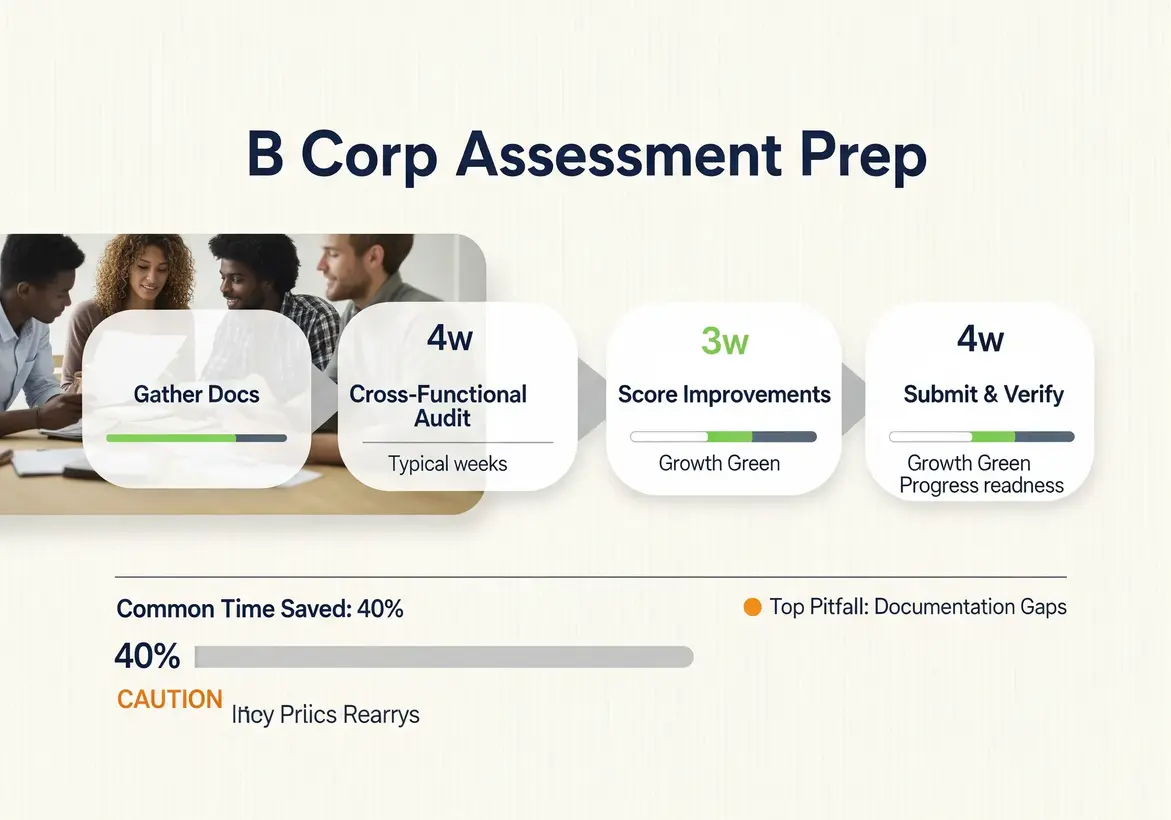
- Implement a Cross-Functional Data Strategy: Appoint a dedicated impact data coordinator, assemble a team with representatives from operations, HR, CSR, and finance. Meet monthly to align metrics, define owners, and close data gaps.
- Leverage AI for Multi-Source Data Collection: Modern AI tools can ingest and analyze qualitative data (employee stories, community feedback, open-ended survey responses) to deliver pattern recognition at scale, reducing human bias and interpretation error.
- Structured Internal Communication Plans: Circulate templated updates explaining data requirements, timelines, accountability structures, and feedback channels. Transparency in requests encourages timely, authentic engagement from all levels.
- Systematize Stakeholder Feedback: Utilize digital platforms that allow real-time input from a broad spectrum of stakeholders. Validate results through triangulation—comparing sources across stakeholder groups for consistency.
The trust gap between what companies claim in ESG reporting and what stakeholders believe is narrowing—only for organizations able to demonstrate robust, transparent methodologies. (Source: WEF, Stakeholder Capitalism Metrics 2021)
Crucially, resilience lies in seeing setbacks (such as incomplete data or disputed metrics) as signals to adapt engagement or escalate internal support, rather than as project limitations.
What are the core principles of the AQAL model used in leadership development?
While impact measurement frameworks provide structure, effective leadership is what operationalizes stakeholder capitalism. The AQAL (All Quadrants, All Levels) model, foundational to integral leadership and widely adopted in advanced organizations, guides leaders to see the full spectrum of stakeholder impact—internal and external, individual and collective, seen and unseen dynamics.
AQAL’s core principles for stakeholder capitalism:
- Holistic Lens: Leaders evaluate decisions through multiple lenses—individual mindset, collective culture, behaviors, systems, and environment. This prevents “blind spots” (e.g., assuming strong values ensure strong systems, or vice versa).
- Multi-level Intervention: Actions are aligned at individual, team, and organizational levels for greater coherence and sustained impact.
- Interconnectedness: Recognition that no single stakeholder’s interest sits in isolation; changing one element affects all.
- Adaptive Measurement: Metrics are tailored by context and level—for example, qualitative outcomes (like employee empowerment) are valued alongside quantitative KPIs (like emissions reduction).
Drawing on TII’s two-decade integral methodology, organizations that integrate AQAL find their impact measurement programs not only more robust, but also more credible with both internal and external stakeholders.
Tools of the Trade: Best Stakeholder Impact Reporting & Measurement Software
Selecting the right tool is critical for scalable, verifiable impact reporting. The market offers a spectrum of solutions—some lean, some enterprise-grade. An effective solution must align with your measurement framework, support stakeholder engagement, and streamline data workflows from collection to presentation.
Leading Solutions:
- Simply Stakeholders: Strong in stakeholder mapping, engagement tracking, and feedback analysis. Suitable for organizations prioritizing stakeholder mapping and conversation history.
- ImpactMapper: Excels in capturing qualitative and quantitative metrics, offering customizable dashboards and reporting templates. Used by mission-driven businesses seeking to blend stories with data.
- Bonterra Impact Management: Noted for advanced data workflows, grant tracking, and alignment with B Corp, GRI, and SDG metrics. Designed for organizations reporting to investors or certifying bodies.
- Excel + Custom Dashboards: For micro and SME businesses, manual solutions offer budget flexibility, but require rigorous internal process design to ensure reliability.
Feature Breakdown Matrix:
| Feature | Simply Stakeholders | ImpactMapper | Bonterra | Excel/Manual |
|---|---|---|---|---|
| Stakeholder Mapping | Advanced | Good | Moderate | Manual |
| Qualitative Analysis | Moderate | Advanced | Good | Limited |
| Integration/Automation | Moderate | Moderate | Advanced | Low |
| Pricing Model | SaaS (Mid) | SaaS (Mid-High) | SaaS (Enterprise) | Free/Custom |
| B Corp/GRI Alignment | Yes | Yes | Yes | Manual |
Recommendation Tip: Define your must-haves first: advanced mapping, narrative reporting, or cross-platform integration. Match budget and internal capabilities to the tool’s learning curve and support resources. For corporations preparing for third-party certification, prioritize platforms with robust audit trails and multi-user controls.
Crafting Compelling Narratives: Best Practices in Impact Reporting (B Corp Focus)
The highest-impact reports are not just data dumps—they are coherent narratives that build trust, inspire action, and pass regulatory scrutiny. B Corp Impact Reports set the standard for clarity, transparency, and creativity.
Core Elements of a Strong Impact Report:
- Transparency: Methodology, baselines, and progress are as visible as outcomes. Reports include successes as well as setbacks, framed as opportunities for learning.
- Data Storytelling: Blend hard metrics (e.g., carbon reduction) with qualitative impacts (e.g., employee testimonials) to create a relatable, authentic voice.
- Visual Appeal: Design reinforces clarity, using infographics, dashboards, and case vignettes for easy stakeholder navigation.
- Materiality: Focus on issues that matter most to those affected—materiality matrices inform which data points and stories take precedence.
- Actionable Pathways: Include next steps and targeted improvement areas, strengthening accountability.
B Corp Impact Report Checklist:
- BIA or GRI-aligned metrics clearly referenced
- Integrated feedback from at least three key stakeholder groups
- Narratives and visuals grounded in audited, traceable data
- Inclusion of both quantitative progress and qualitative stories
- A roadmap for future commitments—clear KPIs for the year ahead
Reports that stand out (see Notepad Studio’s visual gallery) combine robust quantitative info with emotional resonance. For those aiming to master transparency in impact reporting, emphasize proactive leadership accountability in documentation and open communication, closely mirroring practices discussed on leadership accountability in decentralized business units.
The Future of Impact: Emerging Trends to Watch
AI and Data Precision: Cutting-edge tools now offer real-time monitoring and verification of impact data. The ability to validate claims using external datasets—such as community or environmental sensors—shifts impact reporting from “visibility” to “verifiability.” Organizations incorporating AI-driven analytics see a 30%-40% reduction in manual reporting time and a marked reduction in unintentional reporting errors.
Community-Led Data Collection: Future accountability will be anchored in the “open source” ethos, where impact data includes validation from affected communities, not just internal teams.
Dynamic Materiality: Rather than static issues lists, leading companies now use annual stakeholder engagement cycles to adapt priorities, ensuring that impact reporting remains relevant as risks and opportunities evolve.
Over 60% of B Corps surveyed update their materiality assessments annually, keeping impact reports actionable and credible in the eyes of both investors and communities. (Source: B Lab, GRI, 2022)
Integrated Value Chains: The next decade will see organizations holding suppliers and partners accountable for shared impact outcomes—requiring harmonized metrics and transparent collaboration across boundaries.
When should a company conduct an organizational culture assessment to support change leadership?
Organizational culture stands as the bedrock of both stakeholder capitalism and effective impact measurement. The optimal moment for a culture assessment is during impending or active transitions such as mergers, leadership changes, or in the wake of shifting ESG objectives. Drawing on the Integral Model’s multi-level framework, such assessments reveal alignment gaps between stated values and real-world behaviors—enabling targeted, effective change leadership.
Frequent touchpoints include:
- Pre-Implementation of Major Impact Initiatives: Culture diagnostics highlight potential resistance points as early warnings.
- Post-Crisis Recovery: After reputational, ethical, or operational crises, fresh insights guide authentic rebuilding and transparent communication.
- Annual Strategic Review: Embedding culture assessments into routine performance cycles keeps culture accountable as a living, evolving asset.
Real change is not managed in isolation—a culture assessment supports change leadership by uniting stakeholder values, employee engagement, and leadership vision.
Building Trust & Credibility: Verification and Stakeholder Engagement Strategies
Multi-stakeholder engagement is not simply a checkbox for compliance; it’s the operational heart of impact leadership. Organizations succeed when they move beyond transactional relationships to continuous, authentic engagement. Measurement must capture this relationship, not just activity.
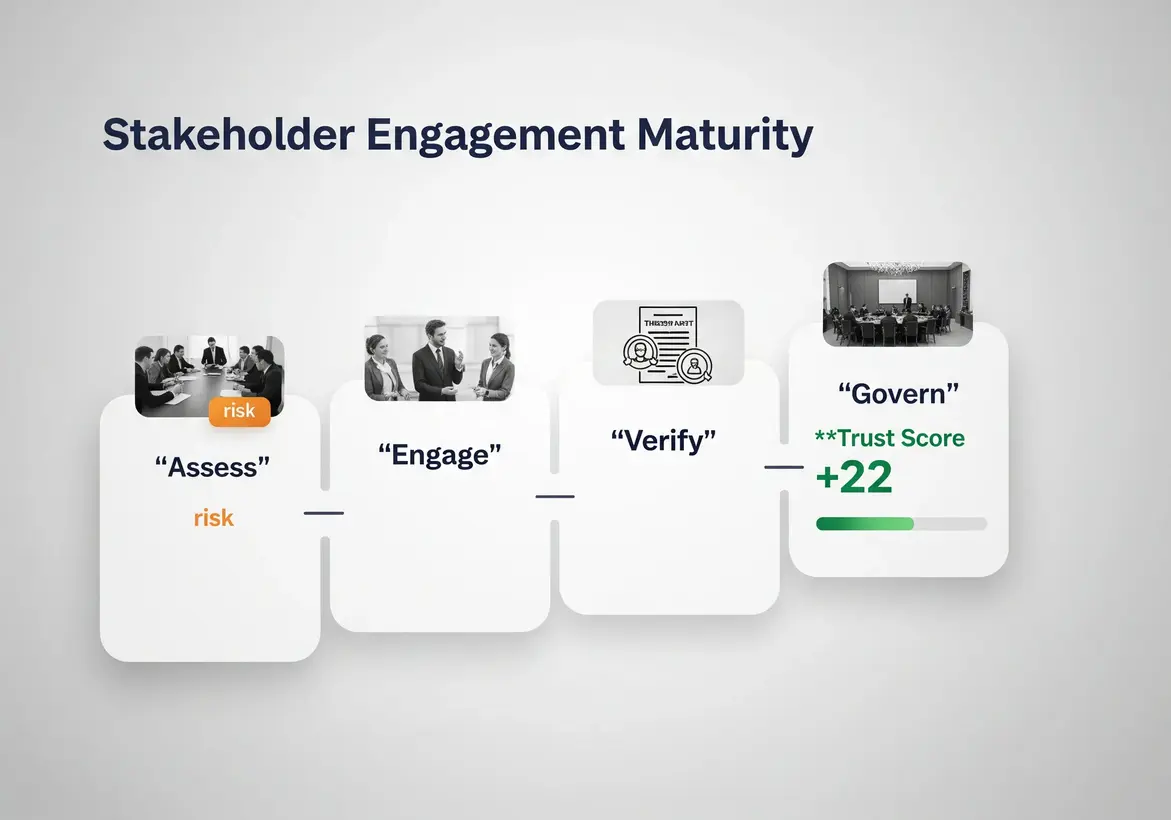
Stakeholder Engagement Maturity Model:
- Early Stage: Engagement is ad hoc. Feedback is collected after-the-fact or through annual surveys.
- Developing: Stakeholder groups have defined touchpoints and input into materiality assessment. Engagement is tracked in specialist software.
- Advanced: Stakeholder dialogue is ongoing and fully integrated into business planning, with transparent reporting cycles. Stakeholders co-design impact initiatives, and their satisfaction informs performance appraisals and resource allocation.
Practical strategies to accelerate from “developing” to “advanced”:
- Establish cross-stakeholder advisory boards for project governance.
- Schedule quarterly engagement reviews; use dashboards to showcase real-time progress.
- Build feedback loops into impact measurement, using digital platforms for inclusive, multi-lingual participation.
- Invest in capacity building for employees as internal ambassadors for stakeholder engagement.
Resilient organizations consistently ground impact measurement in active listening, rigorous data verification, and visible responsiveness to stakeholder priorities.
FAQ: Stakeholder Capitalism & Impact Measurement
What are the core principles of the AQAL model used in leadership development?
The AQAL model, foundational to many integral leadership approaches, encourages leaders to assess issues across individual mindsets, collective culture, visible behaviors, and system-wide processes. This holistic view ensures impact strategies consider both the measurable and intangible aspects of organizational performance, helping leaders recognize and close critical blind spots in stakeholder value creation.
How can integral coaching address the root causes of organizational performance challenges?
Integral coaching explores both surface-level behaviors and deeper drivers such as mindset, values, and systemic barriers. By working at individual, team, and organizational levels, it enables leaders to identify the real sources of disengagement or underperformance—often linked to unaddressed stakeholder needs—enabling more effective interventions aligned with stakeholder capitalism principles.
Why is a multi-level approach important when designing leadership training for executives?
A multi-level approach aligns personal leadership growth with team dynamics and organizational culture. Since stakeholder capitalism requires system-wide adaptation, training that bridges these levels ensures executive leaders are equipped not only to set strategies but also to implement them across all stakeholder touchpoints, from governance to frontline engagement.
Can tailored leadership interventions help organizations navigate disruption and uncertainty?
Yes, research shows that bespoke interventions—rooted in specific organizational goals, industry context, and stakeholder landscapes—are more effective at building resilience. Tailored approaches allow leaders to address unique pain points, build trust, and sustain momentum during transitions such as digitalization, ESG reporting escalation, or stakeholder activism.
When should a company conduct an organizational culture assessment to support change leadership?
A culture assessment should be conducted during major organizational changes, leadership transitions, prior to launching significant impact initiatives, or routinely through annual strategic planning. These assessments help align stakeholder values and organizational behaviors, clearing the path for successful impact measurement and change management.
Who should be involved in executive workshops to maximize transformational outcomes?
Executive workshops for stakeholder capitalism and impact measurement should include senior leadership, strategic HR, CSR/ESG officers, selected board members, and—where appropriate—external stakeholders such as community leaders or key customers. Inclusive participation ensures robust scenario planning and more effective collective buy-in.
Is integrating individual, team, and organizational development more successful for sustained performance improvement?
Yes, research and practical experience show that performance gains are significantly higher when leadership and impact capabilities are developed at all levels. This integration leads to coherence between vision, behaviors, and systems—creating durable, self-sustaining transformation rather than short-term programmatic change.
For leaders navigating the complex realities of stakeholder capitalism and impact measurement, clarity comes not from having all the answers but from committing to transparent dialog, ongoing improvement, and auditable evidence of impact. The journey toward stakeholder value does not end with a framework or software adoption—it advances each time leaders invite stakeholders into the process and ground reporting in what truly matters.
What element of stakeholder capitalism will your organization prioritize next—and how will you verify its impact for those who matter most?
Continue Your Leadership Journey
- Impact reporting frameworks — How to build measurable, credible CSR and sustainability strategies with best-in-class social and environmental impact reporting.
- Stakeholder engagement — Explore integral leadership models that transform stakeholder relationships and drive authentic organizational change.
- Stakeholder mapping — Tailored approaches for regional stakeholder analysis and effective, community-centered business growth.
- Transparency in impact reporting — Best practices for transparent impact governance and leadership accountability in multi-unit and decentralized organizations.